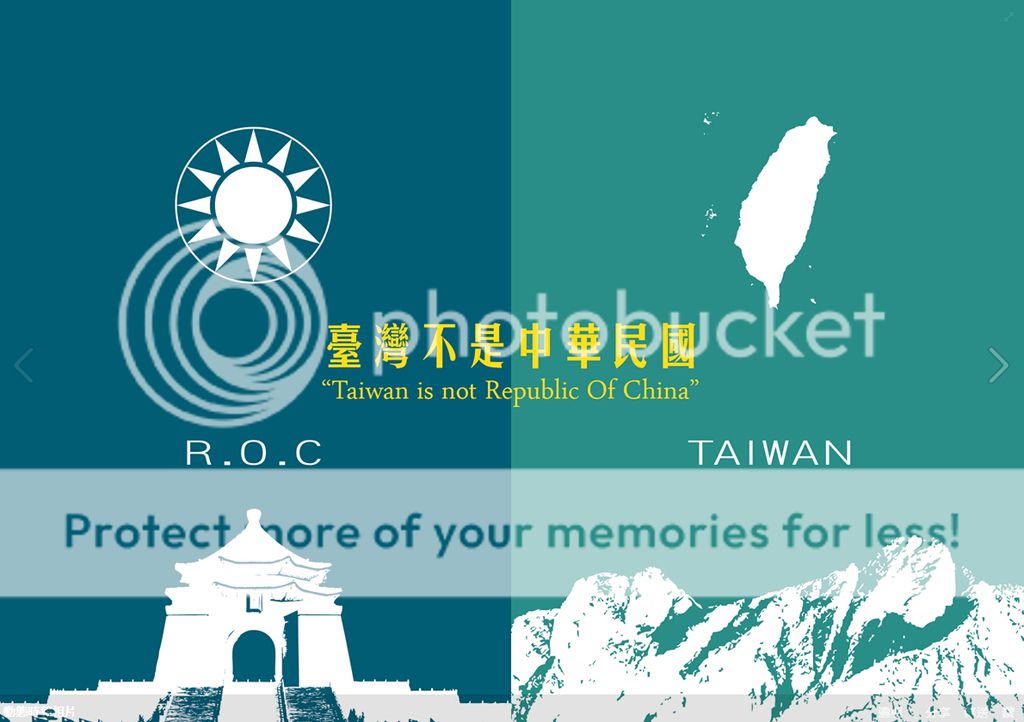
If you are familiar with international law and followed Taiwan closely, you'd know that the Republic of China is a government-in-exile.
Governments in exile are normally not permitted to issue currencies in host territory, even for own use by nationals. Issue of currencies has to be undertaken by government of the host State.
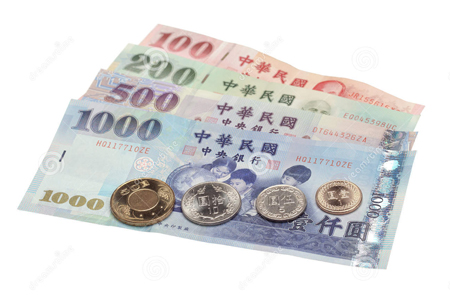
The Republic of China in Taiwan is an exception. Since the territory of Taiwan is not a sovereign State, and the Government of Republic of China has jurisdiction over Taiwan, it has to issue currency for the use of Taiwanese people.
The issue of currency is subjected to the rule of territorial sovereignty. Since the Republic of China does not possess sovereignty over Taiwan, the currency is identified as New Taiwan Dollar instead of the Republic of China Yuan, regardless of how the government like to call the currency domestically.
The case of Taiwan is where a government-in-exile having jurisdiction over its host territory. A government-in-exile will always have no sovereign title over its host territory. The Government of Republic of China exercises governance through military occupation. Even though we see no soldiers on the streets of Taiwan, military occupation continues nominally.
If you'd like to know more about government in exile, there's a book by an international lawyer, Stefan Talmon: Recognition of governments with particular reference to governments in exile.
I have been learning up about the status of Taiwan for the past one year, and writing up my learning into a book.
I have finally figured out the true nationality status of my favourite idol, TWICE’s Chou Tzuyu.
Without a serious incident breaking out, we will not bother about the underlying issue that causes it. The underlying issue of the Chou Tzuyu flag controversy is the question of sovereignty for Taiwan.
I admit that I had no awareness of the importance of international law all my life. Having a background in science, I decided that I learn up the subject to answer this question. This question involving international law is one of the toughest I have dealt with. After crossing many hurdles, I have mastered it with confidence. I was willing to approach the subject for my idol.
International law, more than just formalities for diplomats and politicians, permeates in our lives as ordinary individuals. One of the central theme of international law is sovereignty. The main body of sovereignty is the State, and territorial sovereignty is subsidiary held by the State. At first, international law dealt with States, over time the law developed to accommodate international organizations, war, international responsibility, waters, airspace, health and many more everyday concerns.
Nationality is a political need of everyone that is governed by domestic laws. As a matter of principle, each State have the sovereignty to determine who are its nationals. It should not be neglected that nationality is governed by international law especially in times of war. We are no longer living in the days of conquest equals gaining sovereignty. The laws governing armed conflict not only tells soldiers how to behave in a battlefield, but also provides for legal status of territories involved in war. Today, countries at war are not to indiscriminately naturalize people belonging to the enemy.
In war, enemy territories may come under control of soldiers. The territory is said to be under military occupation. The key principle is that military occupation of enemy territory does not transfer sovereignty to the occupying State. Military occupation is allowed for the occupying State to achieve war objectives, after which the occupying State must withdraw from the territory once the war ends. Throughout occupation, public order must be maintained.
As for the case of Taiwan, it is convenient for us to start with the Treaty of Shimonoseki. It is a treaty of peace signed between the Qing Empire and Japan to terminate the First Sino-Japanese War. The treaty provides for cession of Taiwan and Penghu to Japan. There is no question about the sovereignty transfer for Taiwan.
It remains debatable whether the Qing Empire was really China. The ruling class of the Qing Empire were the Manchurians. Territory of the Qing Empire comprised Manchuria, China Proper, Mongolia, Xinjiang and Tibet. These territories do not belong to each other, and the Qing Court assigned different forms of government for each territory. China Proper, homeland to the Han Chinese, was a colony of the Manchus. Likewise, Taiwan and Penghu were colonies that were incorporated as part of China Proper. Whilst previous empires have set up outposts in Penghu, no Han Chinese empire has ever governed the island of Taiwan.
When it came to the middle of World War 2, representatives of United Kingdom, United States and China sat down in Cairo to discuss war plans. Taiwan, Penghu and Manchuria were promised to be returned to China to shore up Chinese support to fight against Japan. That was the Cairo Declaration. Sovereignty of Taiwan was in the hands of Japan during World War 2. As Japan must be approached for change of hands for Taiwan, the way to go was to defeat Japan. The Cairo Declaration is not a binding legal instrument because it was merely a statement of common purpose for allied countries, not the final settlement. What more, one cannot locate the Cairo Declaration in "Treaties in Force" issued by the United States Department of State up to this day.
Japan surrendered after the use of atomic bombs against Hiroshima and Nagasaki. Generalissimo Chiang Kai Shek was tasked to take over administration of Taiwan and Penghu as stipulated by General Order No. 1 issued by General Douglas MacArthur, the Supreme Commander for the Allied Powers. It should be noted that sovereignty of Taiwan and Penghu remained in the hands of Japan, as a peace treaty for sovereignty transfer has yet to be signed; and the General Order was a military order not equivalent to a peace treaty. The governance of China on Taiwan is a case of military occupation, and this governance does not transfer sovereignty to China. The notion of “Taiwan Retrocession Day” is false. Likewise, Japan proper came under occupation of the United States. A note is that military occupation conducted during World War 2 is governed by The Hague Conventions.
For the sake of clarity, let me emphasise that from 1945 to 1952, Taiwan should be considered part of Japan, and the Japan came under Allied occupation with United States as the principal occupying power.
The Executive Yuan of China issued a governmental order to “restore the nationality of Taiwanese people to China” starting from the day China took over governance of Taiwan. The move earned diplomatic protests from United States and United Kingdom. The United Kingdom has gone as far as expressing “regret” over the move. However, China responded that the measure was taken for the sake of convenience. Both Western Allied Powers were aware that the change of nationality was unlawful under the circumstance circa 1945, and called for a treaty of cession to be formalized prior to making change in nationality. Strictly speaking, the change of nationality for Taiwan contravened Article 45 of The Hague IV Convention.
Before the victorious nations of the Allied Powers got to settle a peace treaty with Japan, the Nationalist Government of China lost in the civil war with the Communists and fled to Taiwan. Starting from that point, the Nationalist Government became a government-in-exile. There has only been one case which the occupying State went into exile in an occupied territory. The Communists founded the People’s Republic of China, the new government in situ of China.
As the Chinese mainland fell into “unfriendly hands” and Communist China’s intervention in the Korean War on North Korea’s behalf, the United States felt that there was no point to cede Taiwan to China and a change of direction was necessary. In the peace treaty with Japan that ensued, that is the Treaty of San Francisco, it was stipulated that Japan renounce sovereign rights over Taiwan and Penghu as set forth in Article 2 without naming any recipient country. Neither government of China was invited to negotiate and sign the peace treaty. From then on, sovereignty of Taiwan and Penghu are said to be undetermined. The Treaty of San Francisco officially ended the Pacific War.
The Treaty of San Francisco did not end the state of war between China and Japan, thus the Treaty of Taipei served as a supplementary treaty to bring peace between both nations. In the Treaty of Taipei, it was reiterated that Japan renounce sovereign interests in Taiwan, Penghu, Spratly Islands and Paracel Islands as previously spelled out in Treaty of San Francisco. Article 10 provided that all “inhabitants of Taiwan and Penghu” be deemed as nationals of the Republic of China and all juridical persons (companies and organisations) be deemed as belonging to the Republic of China. The provision did not act as a transfer of sovereignty, but merely reaffirm the Chinese government-in-exile’s jurisdiction over Taiwan and Penghu via military occupation. The provision conferred no bona fide Chinese nationality to Taiwanese people, but a simulated nationality for the sake of convenience. In other words, like false coloured pictures, the Chinese nationality imposed on the people of Taiwan and Penghu is a false nationality and identity. The status of Taiwan was not altered by the Treaty of Taipei.
China has long been an empire, and a central tenet to its territory is "all lands under heaven belongs to the emperor". Chinese thinks is that actually governing a territory entails having sovereignty over it. Annexation by invasion was the norm. This became ingrained throughout China’s long history of division and unification with force. Today, international law permits governance without possessing legal sovereignty by means of military occupation, trusteeship or territorial lease.
The state of affairs for Taiwan and Penghu persisted from 1952, the year Treaty of San Francisco came into effect until today. Taiwan does not belong to any State, and has yet to proclaim herself a sovereign State.
In Roger C.S. Lin vs. USA, the United States District Court of Columbia ruled that the Taiwanese population are stateless. In an appeal to the United States Court of Appeal, the judge noted that Taiwanese people have lived without a uniformly recognized government and having an uncertain status that infects their day-to-day lives. The lawsuit’s outcome was limited, as the judicial branch of the United States could not answer political questions. The question over the nationality of Taiwanese people can only be resolved before the international community.
What applies to my idol applies to the entire population of Taiwan. If anyone asks me what is the nationality of Chou Tzuyu, I’d answer you using deep rooted principles of international law. In practical terms, Chou Tzuyu is a Taiwanese. By law, she is a stateless “inhabitant of Taiwan and Penghu”. Her Republic of China nationality is a false nationality for the sake of convenience.
Shift of strategic direction of United States following the Korean War
I have been wondering why Taiwan wasn't returned to China as promised in the Cairo Declaration. It turned out that outbreak of Korean War was the turning point for America's shift of international order for East Asia.
After losing the Chinese Civil War to the Communists, the Chinese Nationalists fled to Taiwan. The United States, having lost confidence in the Chinese Nationalist regime, pursued a policy of not intervening in civil wars. The Chinese Communists were prepared to cross the Taiwan Strait to completely defeat the Chinese Nationalists and unify all of China.
The outbreak of Korean War in June 1950 prompted the United States under President Harry S. Truman to dispatch Seventh Fleet to the Taiwan Strait so as to prevent hostilities between opposing factions of China, while war was ongoing at the Korean Peninsula. Notwithstanding that Chiang Kai Shek was spared from Communist attack, the dispatch of Seventh Fleet threatened strategic interests of the nascent People’s Republic of China.
The shift in US strategic direction for East Asia is reflected in the change of territorial clause in the Treaty of Peace with Japan. In a draft released on 8 May 1950, it was stipulated that Japan renounce Taiwan without naming a recipient country.
The People’s Republic of China, through Premier Zhou Enlai, filed a protest at the United Nations on 24 August 1950, claiming that the United States was invading the Chinese territory of Taiwan with the Seventh Fleet. This motion was tabled in the Security Council on 29 September 1950. All members of the Security Council, except USSR and India, voted against the motion. The Chinese government-in-exile, by voting against the motion, denied that Taiwan is a sovereign Chinese territory. The vote also spared the question of Chinese seat to be resolved immediately, against a backdrop of containing Communism.
Resolution of the Security Council was a bitter defeat for the Chinese Communist Party. Having no formidable navy, their nascent regime was at the mercy of United States.
The Communists, up to 1947 still supported Taiwan independence; changed their direction after 1950 to opposing Taiwan independence and claiming Taiwan as Chinese territory.
People’s Republic of China intervened in the Korean War on 25 October 1950, pushing United Nations solders back to the 38th parallel North, cementing the division of Korea lasting to this day.
Taiwan, originally planned to be returned to China, was not returned to China in the Treaty of Peace with Japan. Similarly Kuril and South Sakhalin were not de jure returned to the USSR. The peace treaty provides a basis to argue for Taiwanese independence in the future, at the same time providing a room for future unification with China. The treaty reaffirmed the United States as the "principal occupying power" over former Japanese territories. By law, Taiwan is currently under friendly occupation of the United States.
This is politics: As situation changes, promises made earlier will not hold.
An issue pertaining to the Taiwan question is the nationality and citizenship of the Taiwanese population. The question of nationality and citizenship is a matter of law, not racial identity per se. At some point in time, citizenship can be altered without the consent of the population involved, without due consideration to law. Since when Taiwanese people have become Chinese citizens?
It is to my knowledge that the Executive Yuan of the Republic of China issued an executive order on 12 January 1946 to restore Chinese nationality to the Taiwanese population effective 25 October 1945, the day when China "regained" Taiwan. The executive order was issued without prior consultation with other Allied Powers.
The sovereignty of Taiwan was transferred to Japan on the conclusion of Treaty of Shimonoseki in 1895.
25 October 1945 is termed "Taiwan Retrocession Day" by the Nationalist Government of the Republic of China. This term is disputed today because de jure sovereignty of Taiwan was not restored to China, since a peace treaty between China and Japan has yet to be concluded. According to British Parliamentarians, the Nationalist Government was merely administering Taiwan on the basis of military occupation based on Japanese Instrument of Surrender and General Order No. 1 issued by Supreme Commander of the Allied Powers. 25 October 1945 can only be accurately named "Taiwan Occupation Day".
On the act of converting the nationality of Taiwanese population to China, a memorandum was sent by the Military Intelligence Section of the Supreme Commander for the Allied Powers to Ministry of Foreign Affairs of the Republic of China, dated 2 April 1946. It raised a few questions:
That the Chinese government to express its views in regard to these individuals:
Individuals of mixed parentage such as Chinese-Taiwanese, Japanese-Taiwanese and Chinese-Japanese.
Taiwanese people who have established residence in Japan and collaborating with Japanese war effort.
People born in Taiwan but elected to remain in Japan rather than being repatriated to Taiwan.
On whether there are laws of the Republic of China governing the citizenship of native and former residents of Taiwan.
The unnecessary restriction on the use of the term "Taiwanese" to refer to the Taiwanese population.
Excerpt from Foreign Relations of the United States, 1946, Volume VIII, The Far East, p. 187-188
Why is nationality of Taiwnese people a matter of concern?
Since the British Parliamentarians contended that the regime of Chiang Kai Shek was exercising authority on the basis of military occupation, the law of military occupation applies. The law of military occupation is governed by Hague Conventions of 1899 and 1907, in which China is a signatory.
The situation in Taiwan after 1945 was that the Republic of China as the occupying power and Taiwan as an occupied territory. Japan remained the de jure sovereign, but with her governmental powers suspended. It has to be noted that the Republic of China was not acting by herself, but as part of the Allies, as an agent of the United States as principal occupying power. The return of Taiwan to China requires a treaty of cession be concluded between the two countries.
The Hague Conventions prohibits that the allegiance of the population in an occupied territory be altered to that of a hostile power. Republic of China was considered a hostile power for Taiwan during the period of World War II, due to the fact that Taiwan was Japanese sovereign territory. Legally, people of Taiwan remain Japanese subjects from 1895 up to 1952. The conversion of nationality of the Taiwanese population to China is a violation of Hague Convention and constitute a war crime.
Moreover, the Executive Order contravened nationality laws of the Republic of China at that time, which was promulgated in 1929.
The Nationalist Government of China continued to impose Chinese nationality on Taiwanese people unlawfully throughout the martial law era. With the rise of Mainland China and the Chinese claim on Taiwan, it is tough to address the question of legitimate nationality for the Taiwanese population. The imposed nationality also poses much problems for Taiwanese people over Republic of China passports, at immigration checkpoints overseas.
Notwithstanding that the Republic of China has lost the Chinese mainland, the nature of its governance in Taiwan has not changed since 1945. By law, Taiwan remains an occupied territory of the Republic of China.
I am a Chinese by ethnicity, no doubt. The Chinese people is considered a nation. As a nation, we are not entitled to commit acts to suit the national narrative, but contravene existing laws. As much as we desire an outcome, the process to achieve it must be done according to law. Only then the Chinese nation will be respected.
Taiwanese entertainer Fanny Liew wrote a piece about identity politics in Taiwan. She contended that Taiwanese and Chinese identity should not be at odds with each other. Her family fled to Taiwan with the Chinese Nationalist (KMT) regime to Taiwan at the conclusion of Chinese Civil War. I showed that her viewpoint is limited by her family background, and the island of Taiwan speaks a different narrative than hers. There are currently three types of identities held by the population in Taiwan: Purely Taiwanese, both Taiwanese and Chinese, and purely Chinese. Each of these types of identification are characteristically distinct from each other, as it turned out from academic research.
I came across this interesting video of Taiwanese parliamentary debate. Over the issue of history syllabus to be implemented in Taiwan, legislator from Democratic Progressive PartyKuan Bi-ling posed questions to Taiwanese education minister Wu Si-hua. The debate took place on 3 March 2015.
I really like this video because it taught us an important lesson on State succession for China in the United Nations by explaining Resolution 2758 and the true nature of handover of Taiwan after World War 2.
Kuan began with Chinese foreign minister Wang Yi's remark of People's Republic of China as the founding member of the United Nations. It caused a stir among ethnic Chinese in Taiwan, because the founding member of the UN was Republic of China. In 1971, Republic of China was replaced with People's Republic of China via Resolution 2758 of the United Nations General Assembly. Kuan mentioned one important keyword in the Resolution, that is "restore". With the Resolution, all rights and privileges of the Chinese seat was restored to the People's Republic of China and unlawful representatives of Chiang Kai Shek expelled from UN.
How can Wang Yi claim that his country founded the United Nations? Kuan said that Wang Yi is right, and ordinary people got it wrong. According to the Resolution, the personality of the ROC is being restored to the PRC. It not only restores the seat, but also restores the PRC to the status of being a founding the UN. In essence, the PRC is being "grafted" to the ROC, thus confirming the sovereignty of the ROC is being succeeded by the PRC. In terms of the United Nations, the Republic of China is the People's Republic of China and vice versa.
The next point of contention raised by Kuan is "Retrocession of Taiwan to Republic of China", intended to be taught in [Taiwanese] schools. This raised serious problems about factual accuracy.
On 25 October 1945, Chiang Kai Shek took over the administration of Taiwan from Japan. In reality, Chiang was conducting military occupation of Taiwan on behalf of the Supreme Commander of the Allied Powers, and the Republic of China has yet to legally obtain sovereignty over Taiwan. Chiang told the truth to one of his subordinate, Chen Cheng about the true nature of his governance in Taiwan, that it was a trusteeship. An important principle in international law is that military occupation does not transfer sovereignty.
Kuan gave us very interesting discussion questions. Who was the founding member of the UN? Which country took over Taiwan from Japan through "retrocession"? The answers are the same, that is Republic of China, pointing to the same sovereign body. And since the ROC has been succeeded by the PRC, sovereignty over Taiwan is carried over to the PRC. Also given that ROC and the PRC refers to the same country, Wang Yi is right in the sense to refer ROC as his country.
Kuan pointed out about the factual inaccuracy of takeover of Taiwan. She objected that takeover of Taiwan was not depicted as "military occupation on behalf of the Allies" but rather "retrocession of Taiwan to the Republic of China" in history syllabus. That is to say, there was no transfer of sovereignty of Taiwan on 25 October 1945, but schoolchildren are being misled into believing that sovereignty of Taiwan went back to China.
Why has Kuan taken sovereignty of Taiwan very seriously? Any question of sovereignty is no joke because it concerns national security. If one accepts the notion that Taiwanese sovereignty was reverted to Republic of China, and given that ROC has been succeeded by the PRC, Taiwan will inevitably be part of the PRC. This gives a foothold for authoritarian China to lay claim on Taiwan.
Clearly, she understands that Taiwanese people do not want their hard earned democratic system to be compromised by China due to false description about sovereignty for Taiwan. It becomes important to deny that China has de jure sovereignty over Taiwan, and accurately describe that Chiang was conducting military occupation as an Allied Commander, or that Republic of China was merely an occupying power over Taiwan.
The Minister of Education responded that the country is founded upon the foundation of The Constitution of the Republic of China and Additional Articles to the Constitution. The DPP legislator immediately rebuked the minister for "not facing the truth".
What is the problem with the Minister's statement? Because we are not lawyers, we only have superficial understanding of Constitutions. Most of us only understand that our Constitution(s) represents our countries, but are ignorant about one important principles of law.
Constitutions are not merely written documents that has power in their own right. For a Constitution to have a life of its own, it must be supported by the power of the people. This principle is what we called constituent power. After all, the people constitute the law, hence the supreme law is called constitution. With the constituent power, comes the power to amend the Constitution.
The Constitution of the Republic of China is drafted to be implemented in Mainland China. With the defeat and relocation of Republic of China to Taiwan, what happened to the Constitution?
Words of the Constitution can be preserved, but the ROC Constitution is now dead. Because, the people have used their constituent power to overthrow the ROC Constitution and created the PRC Constitution as the new law for China. People of Taiwan were subjected to Japanese sovereignty, did not take part in drafting the ROC Constitution and hence have no constituent power for the law. Scholars who went into exile with Chiang Kai Shek told their government: Not a single word of the Constitution can be changed. In principle, since the constituent power has been lost, the Constitution cannot be cited to give legitimacy.
The ROC promulgated an executive order on 12 January 1946 to revert citizenship of Taiwanese inhabitants to Chinese. Since China was only an occupying power without sovereignty over Taiwan, such a conversion of citizenship constitute a war crime, and also in violation of nationality laws of the ROC at that time. One can figure that sovereignty of Taiwan remained with Japan from 1945 through to 1952, when the Treaty of San Francisco came into force.
The minister was ignorant about the fact that Taiwan is not included in the territory defined in the ROC Constitution. Implementing the ROC Constitution outside the sovereignty of China does not give the document a new life. The Additional Articles, although serving the purpose to govern Taiwan as a government-in-exile, are in fact unauthorized insertions done by people holding no constituent power. Without power that comes from the rightful people, the ROC Constitution is only a zombie.
It seems that China is not sparing entertainment from its enforcement of One China Principle and “both sides of the Taiwan Strait belongs to One China”, leading to a spat between Chinese and Taiwanese delegations at Tokyo Film Festival.
At the Tokyo Film Festival, the Chinese delegation demanded that the Taiwanese delegation to register at the film festival under the name “Taiwan, China” and that Taiwan enter the red carpet as part of the Chinese delegation. The demand was presented at the last minute of the event. Of course, this was refused by the Taiwanese delegation.
In response, the head of Chinese delegation taunted rudely.
As the matter could not be resolved, the organiser decided to bar both delegations from attending the red carpet. In the press conference that followed, Vivian Hsu tearfully declared that “I am Taiwanese and not a Chinese.”
China regained governance of Taiwan from Japan after World War II, followed by a civil war that led the retreat of Chinese Nationalists to Taiwan in 1949. The peace treaty with Japan concluded in 1951 did not hand Taiwan to any country. Democratisation instituted by Taiwanese President Lee Teng Hui led to distinct social and political environment on the self-governed island, leading to the evolution of separate national identities on China and Taiwan. Separate identities is further consolidated as China rises as a global power.
People’s Republic of China has insisted on the One China Principle for diplomatic relations and opposes policies that lead to separate Chinese and Taiwanese identities, such as “One China, One Taiwan” and “Taiwan Independence”.
In Taiwan, people with singular identification of being Taiwanese are on the rise, becoming more prevalent among the younger generation. Dual identification is declining, and singular identification of being Chinese is only a small minority.
Identity politics is going to affect cultural exchanges across the Taiwan Strait. Judging from the incident, it seemed that Beijing is intolerant of identity politics in all dealings with Taiwan.
Do you hear that? Head of delegation: The Chinese delegation is the sole representative of China in the film festival. The Taiwan delegation is part of the Chinese delegation.
We can see shitty attitude of the female interpreter from Mainland China:
Female interpreter: You are Taiwan, China! Head of Taiwan delegation: I am not. Female interpreter: Are you Chinese? Head of Taiwan delegation: I am Taiwanese. Female interpreter: You are a Chinese! Head of Taiwan delegation: There is no need for this. Don't force me to give in with your mob!
This is how Taiwan Affairs Office of Mainland China responded to the Tokyo Film Festival spat:
Spokesman: The spat may have been caused by lack of communication between two sides. Both sides should refrain from unnecessary conflicts in international settings.
The Taiwan Affairs Office dared not criticise Chinese citizens. Really? It was Mainland China who provoked the Taiwan delegation. The blame should be on the Chinese delegation.
Scratching on the surface, it seems that the Republic of China equals Taiwan, and the Republic of China currently represents Taiwan. Many people claim that Republic of China is the official name for Taiwan.
The confusion and mixing up of Taiwan and Republic of China continues until this day. Isn't this puzzling considering that Taiwan is calling itself Republic of China? Why isn't Taiwan calling itself with an official name that refers to itself, but a neighbouring country?
There is a bit of history involved in this. I must bring up the matter of Chinese Civil War, because it created the unique scene today. The Republic of China was founded by the Chinese Nationalist Party, and the Chinese Communist Party was formed some time after. War erupted between the Chinese Nationalists and Chinese Communist over the system of government to be implemented in China. The Nationalists wanted a constitutional republic but the Communists wanted to form a socialist republic. The Nationalists lost to the Communists and retreated to Taiwan, relocating their seat of government and bringing all national symbols (flag, official name, national anthem) with them. They rule over Taiwan and creates the impression that Taiwan and Republic of China are no different.
From our first impression, Taiwan equals to the Republic of China, and the Republic of China equals Taiwan. The flag with a sun on a blue sky, on a background of red represents Taiwan. There seems to be nothing wrong. Everything seem to be in their place, as we see from the outside.
But when I ask,
What is the Republic of China?
What is Taiwan?
Many think that both refer to the same thing.
But don't you think there's something wrong here? Does Republic of China refer to Taiwan, or China? Does Taiwan equate to being China?
At this point, most people can tell that Taiwan is not China. But there will be people defending that Republic of China is Taiwan. And insist that using the name "Republic of China" is nothing wrong, since it represents a country.
But when posed with the question,
Why Republic of China cannot join the United Nations? Why Taiwan cannot join the United Nations?
Most people do not have a clear idea on the matter to answer this question. To answer this pressing question of international dignity, one needs background in international law, at the very least.
And most importantly,
Where does the Republic of China flag, or the so called Taiwanese flag, come from?
What hinders the return of Taiwan to the international community is the confusion between Taiwan and Republic of China. Learned experts are not confused, but the majority of laypeople are not able to differentiate the two names. Under the One China Principle, there can only be one government that represents China. The right to use the name of China, and the right to represent China is currently held by the People's Republic of China.
In order to find a way out for Taiwan, first the names must be precisely and unambiguously defined.
Taiwan Area as defined in the international peace treaties
Taiwan: An island located off the coast of East Asian continent. For a very precise delimitation, the area of Taiwan should be referred as the area ceded to Japan in the Treaty of Shimonoseki and the same area detached from Japan in Treaty of San Francisco. The area of Taiwan includes (i) The island of Taiwan and other small islands associated with it, and (ii) The archipelago of Penghu, that is all islands lying between the 119th and 120th degrees of longitude east of Greenwich and the 23rd and 24th degrees of north latitude.
China: A unified country occupying a large area on the East Asian continent. It was ruled by dynasty over the course of history, and the territory of each dynasty is different. Her sovereign territory includes the Kinmen and Matsu Islands.
Now let us define "Republic of China" and "People's Republic of China". Are both the same?
Territory of the Republic of China upon its founding. Notice Taiwan is not its territory.
Republic of China: The republic in East Asia that was formed in 1911, after the overthrow of Qing Dynasty, ending thousands of years of imperial rule. This is the official name of the Chinese republic from 1911 to 1949. It's territory includes present-day Mongolia, and did not rule Taiwan for most of its time. It became a government-in-exile after the Chinese Nationalists lost the civil war with the Communists, and relocated to Taiwan.
Internationally recognised sovereign territory of People's Republic of China.
People's Republic of China: A socialist republic founded by the Chinese Communists after they defeated the Nationalists in a civil war. The official name of China after 1949.
Republic of China and People's Republic of China actually refers to the same country, that is China! The actual Republic of China is the republic from 1911 to 1949. These are two different eras of China, much like succession of dynasties. In terms of international law, Republic of China is followed by the People's Republic of China with a State succession event.
Taking history into account, Taiwan does not equal to Republic of China! Know how to differentiate between these names is the key to understanding issues like Taiwan independence. Finding a way out of Taiwan's international isolation also requires this knowledge.
A consequence of the Chinese Civil War is the mixing up of the identity of Taiwan and a previous Chinese government. Name rectification is way to go for Taiwan!
In the midst of Lim Guan Eng house-buying controversy, opportunist Ridhuan Tee urged that Penang be restored to Kedah. It appears clear that he has a sinister agenda. A remark that touches on the bottom line of Penangnites is unacceptable.
There is no denial that Penang was once part of the Sultanate of Kedah. Kedah ceded Penang Island to the British East India Company in a treaty signed 1786, in exchange for military assistance from the latter. When Kedah was attacked by Siam, Francis Light failed to provide military assistance that was promised earlier, thus dishonouring the treaty. Kedah tried to retake Penang in 1790 but was defeated.
The British East India Company, as the victor, dictated the terms of the 1791 treaty. In the 1791 treaty, the Sultan of Kedah cede Penang Island to the Company for an honorarium. The British East India Company took Seberang Prai in 1802 for an increased honorarium. An honorarium is a payment which the giver has no legal obligation to do so. There is no question that treaties signed between Kedah and the Company were unequal treaties.
The political reality is, Penang and Seberang Prai went under separate governance since Kedah ceded it to the British East India Company. Penang’s status was changed to Straits Settlements, then came under direct British rule as a Crown Colony in 1867. The handling of Kedah to British in the Anglo-Siamese Treaty of 1909 did not change the reality of separate governance. Kedah became an Unfederated Malay State and Penang a Crown Colony.
Today, in the Constitution of Malaysia, Article 1 enshrined that Penang and Kedah are two separate states, and territories of the states can only be altered by Parliament with the consent of the respective states. Penang and Kedah are two sovereign equals as part of Malaysia.
The Penangnites have worked hard to develop Penang into a vibrant city-state today. Penang has her own values distinct from her neighbouring state. Terms of the treaties that have been executed are done, so there is no turning back. The call for Penang to return to Kedah is reflective of the pre-Independence mentality. There is no reason for Kedah to reclaim Penang today.
There is no question on the status of Penang. There is no question of territorial integrity in Peninsular Malaysia. Anyone attempting to undermine the status of Penang goes against the Constitution and can be held guilty of sedition.
Oil prices are tumbling down in a descent that is fueled by the weak global economy and the increased shale gas production in the US. The US had made much efforts in the past few years, backed by technology and investments, to free itself from over-dependence on Middle East oil.
With ISIS posing a major regional threat that could throttle oil production in the volatile Middle East, the US and other nations are wary of the economic consequences. This is the main reason for the intense shale production in the US.
In the future, oil prices will be more stable and affordable, and the oil windfall for the OPEC countries could be a thing of the past.
Saudi Arabia’s strategy of keeping oil prices low to drive out US shale gas supplies is a no-brainer. It is not going to have a major effect. The US will do its best to maintain shale gas production, including subsidising it, for its domestic use. The days of using oil as a weapon against the US are truly over. President Barack Obama, being more of a statesman than a politician, has done much to relieve the US of such threats.
The Middle East is in turmoil and nations too dependent on oil from the region must plan and prepare themselves from any eventuality by opting for other sources of fuel.
In the short term, major oil producers like Russia, Iran, Venezuela, Indonesia and others who depend much from oil export revenues could be in trouble.
For Malaysia, hard times are ahead and the days of carefree spending with Petronas profits are surely over. We know how much our government has abused our petrodollars. For example, the administrative capital of Putrajaya – which should be called Petrojaya instead – was built using billions of petrodollars when this precious money could have been used fruitfully for more important programmes and initiatives to diversify the economy so that we wouldn’t be too reliant on a depleting resource.
How the low price of oil is going to affect international politics and economics in the new year is yet to be seen. The US shale gas production is here to stay and is going to reduce and stabilize oil prices for the good of the global economy. The immediate beneficiaries will be major economies like China, Japan, India, the EU and the US itself. These economies could be re-energised, bringing multiplier or spillover effects for the world economy.
The situation above is best described as interracial infatuation rather than interracial/interfaith relationship. The video may be shallow, but has given us enough points to ponder. Out of all types of interfaith relationships, Islam draws the most controversy.
Under Malaysian law, any person who's marrying a Muslim must convert to Islam prior to marriage, regardless of male or female.
The harsh fact in Malaysia is, most Chinese refuse to have anything to do with Islam. Many are not open to marrying Malays. Religion can be the sole reason for rejection. Many Chinese families mount resistance should they ever find out their sons/daughters are in a relationship with a Malay. They'd choose to preserve their culture and belief from generation to generation.
The real culprit behind this is political Islam. In all Abrahamic faiths (Judaism, Christianity & Islam), not only the faiths provides guidance to believers but they exert political control over people in the Middle East throughout history. In the Scriptures of these religions, it's all about control over people if you are familiar with their contents.
There's little problem when the church is separated from the state. But not in Malaysia, the 'church' (mosque) remains under jurisdiction of the state. The Mosque is government backed, to make matters worse. Hence the contention shown in the video rears its ugly head.
Namewee (real name Wee Meng Chee) has a word to say in response to the petrol price hike. But he did it differently this time - he spoke in an alien tongue to us! I was so taken aback with his acquisition of "Korean".
It's fairly easy to understand just by watching what he shows without the need to understand what he actually says. But if you're not Malaysian and don't know what actually happened, this is what he mean to say through the pictures:
Since the petrol price hike, the government is making our lives harder! Whatever fuel that's sold by Petronas, Shell, Caltex and Mobil, they're all raised by 20 cents. Aissshh! The Malaysian government is picking on us Chinese people, with the Chicken and Horse Screw messing up the government and think that they hold absolute power in the country. Really, all of you are sick! Do you want us to drink plain water, eat plain bread and ride on our bicycle so that you'll be satisfied with everything?! Aisssh, Aiish, then what do you want?! Before this you spent public money to bring Psy (Park Jae Sang) to Penang, where everyone enjoyed a free show; when election comes you gave so many goodies to people, furthermore you spent so much to bring Bangladeshi migrant workers to vote for you, only to raise the price of petrol to pay the bills after all these while? Is your dick bigger that we do? Certainly you can't do that to us. Aisssh, what do you want from us? Isn't it. Are these our fault? By doing this you only make crime pay. Aisssh! I'm really fed up with you...
Now you've got what you needed to know, aren't you? But in fact there's actually more, so read on to fulfil your curiosity!
I listened to Namewee's speech carefully and it led me to new findings! There're so many secrets to this video. I've even gone to extra mile of sharing the video to people that may know about Korean language. If you have been following Namewee since his early days, he is indeed famous for swearing in his videos to get his message across. By paying attention to his speech you'll notice these words:
Jenjang: A Korean swear word.
Shibal: That's a very bad Korean swear word.
Gae seki: That's also a Korean swear word.
Puniabo: Possibly a Hainanese swear word. From what I heard, Namewee has a Hainanese ancestry.
Gamsa hamnida: Korean word for "Thank you". Namewee was probably referring that the current Malaysian government ought to thank the Chinese people for their contribution. On the other hand, ruling party politicians that lose their seat in the 2013 General Election retorted that Chinese people "were not grateful". A majority of Chinese people has voted in favour of the opposition coalition during the election.
Kim Il-Sung, Pyeongyang, Kim Jong-Il: He's referring to transfer of power in North Korea and draws a parallel between North Korea and Malaysia. The current Prime Minister of Malaysia (Najib bin Abdul Razak) is the son of former Prime Minister Tun Abdul Razak bin Hussein.
Namewee Tokok episode 19 is made up of random words with a few curse words, I believe. But since only few of us know about Korean profanities, he could largely get away.
In short, Namewee has voiced our grievance against the petrol price hike. Ask yourself again, what is Namewee famous for? =D
Just two days ago I had a Twitter conversation with my friends about the ongoing BookFest @ Malaysia 2013 held at Kuala Lumpur Convention Centre.
The #BookFest at KLCC organised by Popular lacks diversity. Kena multicultural, multiracial sikit lah.
— Zaim Mohzani (@Zaim90) August 7, 2013
@Zaim90 I don't understand. Books are books.
— Your High Fluffiness (@Kyp_Lim) August 7, 2013
@Kyp_Lim You have a whole hall dedicated to Chinese books and another mixed with English and a bit of Malay books. Need some diversity.
— Zaim Mohzani (@Zaim90) August 7, 2013
Pesta Buku 1Malaysia di PWTC February lepas terlalu Melayu. BookFest at KLCC now is too Chinese. When are we going to have a Msian bookfest?
— Zaim Mohzani (@Zaim90) August 7, 2013
@Zaim90 the Chinese name of the bookfest translates to "Overseas Chinese Bookfest". The organizer has clearly stated the target market
— Chai Boon Kheng (@biopolymath) August 7, 2013
@Zaim90 of the book fair. That's good for one venue - one target market and good offerings.
— Chai Boon Kheng (@biopolymath) August 7, 2013
@zaim90 try 'Malaysiana' as target market. Remains to be seen if will be a success.
— Chai Boon Kheng (@biopolymath) August 7, 2013
@biopolymath You see you can understand the Chinese name but not for those who can't read it. Do read the foreword in booklet, no mention.
— Zaim Mohzani (@Zaim90) August 7, 2013
@biopolymath If so it shld hv instead been named Chinese BookFest. Don't get me wrong I enjoyed the English section but need more choices.
— Zaim Mohzani (@Zaim90) August 7, 2013
Since Twitter isn't allowing me to elaborate further on what I want to say, so I'll tell you more about what I mean to say here.
As I have stated in my Tweet, the Chinese name of the event 海外华文书市 translates to Overseas Chinese Book Fair. That isn't reflected in BookFest @ Malaysia, the official English name of the event. But since my friend Zaim Mohzani can't see the world in Chinese, I have to excuse him. That's a problem when you want to be nice and inclusive in English to appeal to the rest of the nation while your actual target market is in fact, Chinese-speaking Chinese community.
Before I dwell into my analysis, I'd say that BookFest @ Malaysia is a huge success given its target market while Pesta Buku 1Malaysia barely live up to its name.
If you have been to the Chinese section of the book fair, you'll notice that the books are divided into subsections according to their country of publication - China, Taiwan, Hong Kong, Singapore and Malaysia. This has been so since the inaugural event in 2006. Interests garnered from overseas Chinese publishers signals the attractiveness and profitability of the Chinese market. The Chinese population, although making up a quarter of the Malaysian population, is a sizable market for their purchasing power. The attractiveness of the Chinese market is compounded by the fact that many of the Chinese here have inherited deeply rooted cultural ideals from their motherland, aided by thriving Chinese vernacular education.
Now that the organiser has decided on the target market, next comes the question of book offerings. Now that the book fair is divided into three large sections: Chinese, English (& a bit of Malay) and "Lifestyle". The representative section is the Chinese one, hence this is where the name "Overseas Chinese Bookfair" comes in. The critical mass of Chinese publications in the world actually lies in China and Taiwan. The purpose of the book fair is to provide an opportunity for readers to obtain books published overseas under one roof, where these books may not be readily available in Malaysia.
What about the English section? Clearly the organiser did not forget about this segment of the market! But bear in mind that the organiser is Popular Book Co. Malaysia, which sells predominantly Chinese books and reference books for schools. It's undeniable that offerings in the English section may not be as diverse. As much of the weight of the book fair was put into the Chinese section, the organiser has only taken the best attempt to cater English readers and it's entirely understandable.
To answer the question of why Pesta Buku 1Malaysia become a predominatly Malay bookfair, the safe answer I can provide now is the inability of government efforts (or just about anything in Malay?) to cross cultural barriers. So language accessibility does not necessarily translates into visits :(
Why has Zaim Mohzani lamented about lack of diversity in Bookfest @ Malaysia? He "sees" the bookfair in two languages whilst the Chinese section remains largely inaccessible to him. Offerings in the English section is somewhat limited but the Chinese section is actually diverse in one common language. Whether you are making huge gains at the bookfair depends on your language and cultural attributes.
I woke up to the shocking news of four Malay-Muslim contestants Kathrina binti Rizuan, Miera Sheikh, Wafa Johanna De Korte and Sara Amelia Bernard being dropped out of Miss Malaysia World for religious reasons. Regrettably, the contestants affected were dropped out as finalists in the pageant.
The organiser of Miss Malaysia World has allowed Muslim participants from the start. As an alternative to swimsuits, Muslim participants has the option of wearing sportswear during the swimwear competition so as to reduce exposure of skin. Therefore, all contestants should be able to take part in the pageant without bothering their conscience.
Moreover, the grand final of Miss World will be held in Muslim-majority Indonesia.
I share my outrage with the disqualified participants for their hard work all the way from the beginning, only to have their dream crushed at the last minute. Quoting a 'fatwa' banning Muslim women from participating in beauty pageants is questionable in an era we live in currently. It is but a regressive move.
Beauty pageants have evolved to have a charitable function which participants are called to be advocates, ambassadors and perform social work. Moreover, winners of beauty pageants have important role to play in the society. Apart from physical appeal, winners of beauty pageants are judged by how well they carry themselves. To deny Muslim women from taking part in beauty pageants is to deny a share of representation of Muslim women in the society, which in turn undermine the societal role of women.
The move by Federal Territories mufti Datuk Wan Zahidi reeks of blatant double standard and hypocrisy. If he can criticise Muslim women for participating in beauty contests, why has he kept mum for activities that require revealing clothing and very much involved by female Muslims locally - swimming, gymnastics and cheerleading?
I was fuming when I watched the live broadcast of Malaysian Parliament. A Minister was finding all excuses not to provide broadband access to East Malaysia (Sabah & Sarawak). Some excuses cited were "Don't compare Malaysia to Singapore and South Korea", "Difficulty laying cables underneath the South China Sea", "South Korea is a highly urbanised country" and bla bla bla.
Sad to know that people in East Malaysia are left behind in terms of overall development. I'm sure someone can do a better job than him!
Biorefresher 3
It's the 4th year since Teoh Beng Hock has left us. The short film below was made in remembrance of his tragic end.
A Pink is poised for a comeback this Friday! Their title track is revealed to be NoNoNo, part of Secret Garden mini album. Biorefresher 2
Waveya released dance cover for Sistar's Give It To Me.
Biorefresher 3
Barisan Nasional's Kinabatangan MP, Bung Mokhtar Radin asked AirAsia X's CEO Arzan Osman Rani to leave the country over the latter's criticism on an Utusan Malaysia's article. Arzan has earlier criticized an article entitled "What More Does the Chinese Want?" (Apa lagi Cina mahu?) for its racist stance. But, who's Bung Mokhtar? He shot to fame for his "monthly leak" remark on a fellow woman MP from DAP years ago.
A Cube Entertainment released 2nd video teaser for Secret Garden! Let us cheer for A Pink.
Their comeback has also been teased on KBS Music Bank.
Biorefresher 2
Surprise surprise! The High Court judge Datuk V. T. Singham (the one who presided over the case of Kugan's death in police custody) tendered his resignation today, a year before his term is up.
Biorefresher 3 The community defended Jonker Walk in Malacca even though the Malaccan State Government has reversed the decision to close hawker stalls and open the street to traffic. Groups belonging to MCA and DAP took part in the rally.
Taiwanese soloist A Fu revealed her music video for "Unlimited Freedom" 无限度自由 today! It's part of her album Sky Island 天空岛. She'll reveal MVs for two more tracks, More and More Loving 越来越爱 and Angel 天使. Biorefresher 2
Singapore was hit by hailstorm after the haze! Hails do not pose health hazard but make sure you run indoors or wear a helmet if you need to go out.
Girl's Day has released their music video for Female President!Themed on feminism, I watch to my delight as team members Sojin, Yura, Minah and Hyeri transform into mature ladies that also comes with authority.
Biorefresher 2
A Pink teased us with a comeback! They're appealing to you with their innocent charms. Let us look forward to "Secret Garden".
Biorefresher 3
The Malaysian Parliament reconvened (reopened) after the 13th General Election. Elected MPs took oath of office, Pandikar Amin re-elected as Speaker of the House of Representatives and an emergency motion tabled to discuss haze.
Pandikar Amin polled 133 against Kadir Sulaiman's 89 because MPs were compelled to sign on the ballot (if you get what I mean). What did our MPs said about reconvening Parliament in haze?
1st day of 13th Parliament today held under haze, symbolic of widespread questioning of legitimacy of Najib as PM of minority government.
— Lim Kit Siang (@limkitsiang) June 24, 2013
Although the haze today is bad, our spirits are up at the swearing in ceremony at the Parliament http://t.co/bjOL4BUMIU
— KarpalSingh (@KarpalSinghDAP) June 24, 2013