If you are familiar with international law and followed Taiwan closely, you'd know that the Republic of China is a government-in-exile.
Governments in exile are normally not permitted to issue currencies in host territory, even for own use by nationals. Issue of currencies has to be undertaken by government of the host State.
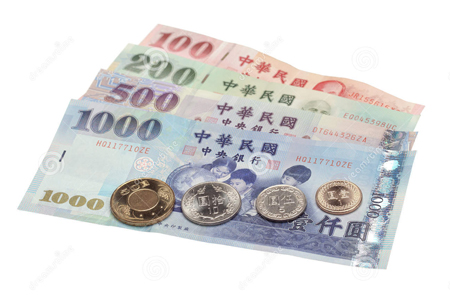
The Republic of China in Taiwan is an exception. Since the territory of Taiwan is not a sovereign State, and the Government of Republic of China has jurisdiction over Taiwan, it has to issue currency for the use of Taiwanese people.
The issue of currency is subjected to the rule of territorial sovereignty. Since the Republic of China does not possess sovereignty over Taiwan, the currency is identified as New Taiwan Dollar instead of the Republic of China Yuan, regardless of how the government like to call the currency domestically.
The case of Taiwan is where a government-in-exile having jurisdiction over its host territory. A government-in-exile will always have no sovereign title over its host territory. The Government of Republic of China exercises governance through military occupation. Even though we see no soldiers on the streets of Taiwan, military occupation continues nominally.
If you'd like to know more about government in exile, there's a book by an international lawyer, Stefan Talmon: Recognition of governments with particular reference to governments in exile.
I have been learning up about the status of Taiwan for the past one year, and writing up my learning into a book.
I have finally figured out the true nationality status of my favourite idol, TWICE’s Chou Tzuyu.
Without a serious incident breaking out, we will not bother about the underlying issue that causes it. The underlying issue of the Chou Tzuyu flag controversy is the question of sovereignty for Taiwan.
I admit that I had no awareness of the importance of international law all my life. Having a background in science, I decided that I learn up the subject to answer this question. This question involving international law is one of the toughest I have dealt with. After crossing many hurdles, I have mastered it with confidence. I was willing to approach the subject for my idol.
International law, more than just formalities for diplomats and politicians, permeates in our lives as ordinary individuals. One of the central theme of international law is sovereignty. The main body of sovereignty is the State, and territorial sovereignty is subsidiary held by the State. At first, international law dealt with States, over time the law developed to accommodate international organizations, war, international responsibility, waters, airspace, health and many more everyday concerns.
Nationality is a political need of everyone that is governed by domestic laws. As a matter of principle, each State have the sovereignty to determine who are its nationals. It should not be neglected that nationality is governed by international law especially in times of war. We are no longer living in the days of conquest equals gaining sovereignty. The laws governing armed conflict not only tells soldiers how to behave in a battlefield, but also provides for legal status of territories involved in war. Today, countries at war are not to indiscriminately naturalize people belonging to the enemy.
In war, enemy territories may come under control of soldiers. The territory is said to be under military occupation. The key principle is that military occupation of enemy territory does not transfer sovereignty to the occupying State. Military occupation is allowed for the occupying State to achieve war objectives, after which the occupying State must withdraw from the territory once the war ends. Throughout occupation, public order must be maintained.
As for the case of Taiwan, it is convenient for us to start with the Treaty of Shimonoseki. It is a treaty of peace signed between the Qing Empire and Japan to terminate the First Sino-Japanese War. The treaty provides for cession of Taiwan and Penghu to Japan. There is no question about the sovereignty transfer for Taiwan.
It remains debatable whether the Qing Empire was really China. The ruling class of the Qing Empire were the Manchurians. Territory of the Qing Empire comprised Manchuria, China Proper, Mongolia, Xinjiang and Tibet. These territories do not belong to each other, and the Qing Court assigned different forms of government for each territory. China Proper, homeland to the Han Chinese, was a colony of the Manchus. Likewise, Taiwan and Penghu were colonies that were incorporated as part of China Proper. Whilst previous empires have set up outposts in Penghu, no Han Chinese empire has ever governed the island of Taiwan.
When it came to the middle of World War 2, representatives of United Kingdom, United States and China sat down in Cairo to discuss war plans. Taiwan, Penghu and Manchuria were promised to be returned to China to shore up Chinese support to fight against Japan. That was the Cairo Declaration. Sovereignty of Taiwan was in the hands of Japan during World War 2. As Japan must be approached for change of hands for Taiwan, the way to go was to defeat Japan. The Cairo Declaration is not a binding legal instrument because it was merely a statement of common purpose for allied countries, not the final settlement. What more, one cannot locate the Cairo Declaration in "Treaties in Force" issued by the United States Department of State up to this day.
Japan surrendered after the use of atomic bombs against Hiroshima and Nagasaki. Generalissimo Chiang Kai Shek was tasked to take over administration of Taiwan and Penghu as stipulated by General Order No. 1 issued by General Douglas MacArthur, the Supreme Commander for the Allied Powers. It should be noted that sovereignty of Taiwan and Penghu remained in the hands of Japan, as a peace treaty for sovereignty transfer has yet to be signed; and the General Order was a military order not equivalent to a peace treaty. The governance of China on Taiwan is a case of military occupation, and this governance does not transfer sovereignty to China. The notion of “Taiwan Retrocession Day” is false. Likewise, Japan proper came under occupation of the United States. A note is that military occupation conducted during World War 2 is governed by The Hague Conventions.
For the sake of clarity, let me emphasise that from 1945 to 1952, Taiwan should be considered part of Japan, and the Japan came under Allied occupation with United States as the principal occupying power.
The Executive Yuan of China issued a governmental order to “restore the nationality of Taiwanese people to China” starting from the day China took over governance of Taiwan. The move earned diplomatic protests from United States and United Kingdom. The United Kingdom has gone as far as expressing “regret” over the move. However, China responded that the measure was taken for the sake of convenience. Both Western Allied Powers were aware that the change of nationality was unlawful under the circumstance circa 1945, and called for a treaty of cession to be formalized prior to making change in nationality. Strictly speaking, the change of nationality for Taiwan contravened Article 45 of The Hague IV Convention.
Before the victorious nations of the Allied Powers got to settle a peace treaty with Japan, the Nationalist Government of China lost in the civil war with the Communists and fled to Taiwan. Starting from that point, the Nationalist Government became a government-in-exile. There has only been one case which the occupying State went into exile in an occupied territory. The Communists founded the People’s Republic of China, the new government in situ of China.
As the Chinese mainland fell into “unfriendly hands” and Communist China’s intervention in the Korean War on North Korea’s behalf, the United States felt that there was no point to cede Taiwan to China and a change of direction was necessary. In the peace treaty with Japan that ensued, that is the Treaty of San Francisco, it was stipulated that Japan renounce sovereign rights over Taiwan and Penghu as set forth in Article 2 without naming any recipient country. Neither government of China was invited to negotiate and sign the peace treaty. From then on, sovereignty of Taiwan and Penghu are said to be undetermined. The Treaty of San Francisco officially ended the Pacific War.
The Treaty of San Francisco did not end the state of war between China and Japan, thus the Treaty of Taipei served as a supplementary treaty to bring peace between both nations. In the Treaty of Taipei, it was reiterated that Japan renounce sovereign interests in Taiwan, Penghu, Spratly Islands and Paracel Islands as previously spelled out in Treaty of San Francisco. Article 10 provided that all “inhabitants of Taiwan and Penghu” be deemed as nationals of the Republic of China and all juridical persons (companies and organisations) be deemed as belonging to the Republic of China. The provision did not act as a transfer of sovereignty, but merely reaffirm the Chinese government-in-exile’s jurisdiction over Taiwan and Penghu via military occupation. The provision conferred no bona fide Chinese nationality to Taiwanese people, but a simulated nationality for the sake of convenience. In other words, like false coloured pictures, the Chinese nationality imposed on the people of Taiwan and Penghu is a false nationality and identity. The status of Taiwan was not altered by the Treaty of Taipei.
China has long been an empire, and a central tenet to its territory is "all lands under heaven belongs to the emperor". Chinese thinks is that actually governing a territory entails having sovereignty over it. Annexation by invasion was the norm. This became ingrained throughout China’s long history of division and unification with force. Today, international law permits governance without possessing legal sovereignty by means of military occupation, trusteeship or territorial lease.
The state of affairs for Taiwan and Penghu persisted from 1952, the year Treaty of San Francisco came into effect until today. Taiwan does not belong to any State, and has yet to proclaim herself a sovereign State.
In Roger C.S. Lin vs. USA, the United States District Court of Columbia ruled that the Taiwanese population are stateless. In an appeal to the United States Court of Appeal, the judge noted that Taiwanese people have lived without a uniformly recognized government and having an uncertain status that infects their day-to-day lives. The lawsuit’s outcome was limited, as the judicial branch of the United States could not answer political questions. The question over the nationality of Taiwanese people can only be resolved before the international community.
What applies to my idol applies to the entire population of Taiwan. If anyone asks me what is the nationality of Chou Tzuyu, I’d answer you using deep rooted principles of international law. In practical terms, Chou Tzuyu is a Taiwanese. By law, she is a stateless “inhabitant of Taiwan and Penghu”. Her Republic of China nationality is a false nationality for the sake of convenience.
Was Taiwan returned to Chinese sovereignty on 25 October 1945?
In order for us to know the significance of the so-called "Taiwan Retrocession Day" it is paramount for us to understand the basis of Republic of China's authority on Taiwan.
First, we must establish that Taiwan was ceded in full and perpetuity to Japan under the terms of Treaty of Shimonoseki in 1895.
On 2 September 1945, Japanese forces surrendered to the Allied Powers. The Japanese Government issued a document called Instrument of Surrender, while the Supreme Commander for the Allied Powers issued the terms of surrender called General Order No. 1. Under the terms of General Order No. 1, Japanese forces in Taiwan and Penghu surrender themselves to Generalissimo Chiang Kai Shek.
On 25 October 1945, Japanese forces in Taiwan surrendered to the Allied Powers in a ceremony. Surrender of the Japanese paved the way for military occupation by Chiang Kai Shek's forces. Authority of Chiang came from General Order No. 1. The basis for Chiang's governance is military occupation. As a rule, military occupation does not transfer territorial sovereignty to the occupying State.
Did any of the Allied Powers recognize transfer of sovereignty for Taiwan, from Japan to China on 25 October 1945? The answer is NO.
On 12 January 1946, the Executive Yuan of the Republic of China issued an order to restore Chinese nationality to the Taiwanese population on and effective from 25 October 1945. This led to diplomatic protests by the United States and United Kingdom. In diplomatic memorandums sent to the Republic of China, both US and UK insisted that transfer of Taiwan's sovereignty be formalized in a treaty of cession with Japan.
Pro-unification camps argued that the Cairo, Postdam and Yalta Declarations could restore Taiwan back to China. Common sense tells us that declarations are statements of intentions which do not carry the force of law. The diplomatic protests are solid evidence that US and UK did not recognize those declarations as having the force of law. Those documents cannot be cited as the basis for return of Taiwan to China. Instead, only a treaty can settle territorial questions.
What's wrong with changing the nationality of Taiwanese population? Firstly, China altered the nationality of Taiwanese people without first obtaining documentary evidence of sovereignty. Secondly, it is a violation of Article 45 of Hague Conventions governing wars on land, since China could only be recognized as occupying power over Taiwan.
25 October 1945 was the day when Taiwan came under Chinese [military] occupation. It can only be called Taiwan Occupation Day.
An issue pertaining to the Taiwan question is the nationality and citizenship of the Taiwanese population. The question of nationality and citizenship is a matter of law, not racial identity per se. At some point in time, citizenship can be altered without the consent of the population involved, without due consideration to law. Since when Taiwanese people have become Chinese citizens?
It is to my knowledge that the Executive Yuan of the Republic of China issued an executive order on 12 January 1946 to restore Chinese nationality to the Taiwanese population effective 25 October 1945, the day when China "regained" Taiwan. The executive order was issued without prior consultation with other Allied Powers.
The sovereignty of Taiwan was transferred to Japan on the conclusion of Treaty of Shimonoseki in 1895.
25 October 1945 is termed "Taiwan Retrocession Day" by the Nationalist Government of the Republic of China. This term is disputed today because de jure sovereignty of Taiwan was not restored to China, since a peace treaty between China and Japan has yet to be concluded. According to British Parliamentarians, the Nationalist Government was merely administering Taiwan on the basis of military occupation based on Japanese Instrument of Surrender and General Order No. 1 issued by Supreme Commander of the Allied Powers. 25 October 1945 can only be accurately named "Taiwan Occupation Day".
On the act of converting the nationality of Taiwanese population to China, a memorandum was sent by the Military Intelligence Section of the Supreme Commander for the Allied Powers to Ministry of Foreign Affairs of the Republic of China, dated 2 April 1946. It raised a few questions:
That the Chinese government to express its views in regard to these individuals:
Individuals of mixed parentage such as Chinese-Taiwanese, Japanese-Taiwanese and Chinese-Japanese.
Taiwanese people who have established residence in Japan and collaborating with Japanese war effort.
People born in Taiwan but elected to remain in Japan rather than being repatriated to Taiwan.
On whether there are laws of the Republic of China governing the citizenship of native and former residents of Taiwan.
The unnecessary restriction on the use of the term "Taiwanese" to refer to the Taiwanese population.
Excerpt from Foreign Relations of the United States, 1946, Volume VIII, The Far East, p. 187-188
Why is nationality of Taiwnese people a matter of concern?
Since the British Parliamentarians contended that the regime of Chiang Kai Shek was exercising authority on the basis of military occupation, the law of military occupation applies. The law of military occupation is governed by Hague Conventions of 1899 and 1907, in which China is a signatory.
The situation in Taiwan after 1945 was that the Republic of China as the occupying power and Taiwan as an occupied territory. Japan remained the de jure sovereign, but with her governmental powers suspended. It has to be noted that the Republic of China was not acting by herself, but as part of the Allies, as an agent of the United States as principal occupying power. The return of Taiwan to China requires a treaty of cession be concluded between the two countries.
The Hague Conventions prohibits that the allegiance of the population in an occupied territory be altered to that of a hostile power. Republic of China was considered a hostile power for Taiwan during the period of World War II, due to the fact that Taiwan was Japanese sovereign territory. Legally, people of Taiwan remain Japanese subjects from 1895 up to 1952. The conversion of nationality of the Taiwanese population to China is a violation of Hague Convention and constitute a war crime.
Moreover, the Executive Order contravened nationality laws of the Republic of China at that time, which was promulgated in 1929.
The Nationalist Government of China continued to impose Chinese nationality on Taiwanese people unlawfully throughout the martial law era. With the rise of Mainland China and the Chinese claim on Taiwan, it is tough to address the question of legitimate nationality for the Taiwanese population. The imposed nationality also poses much problems for Taiwanese people over Republic of China passports, at immigration checkpoints overseas.
Notwithstanding that the Republic of China has lost the Chinese mainland, the nature of its governance in Taiwan has not changed since 1945. By law, Taiwan remains an occupied territory of the Republic of China.
I am a Chinese by ethnicity, no doubt. The Chinese people is considered a nation. As a nation, we are not entitled to commit acts to suit the national narrative, but contravene existing laws. As much as we desire an outcome, the process to achieve it must be done according to law. Only then the Chinese nation will be respected.
I have been pondering about the Treaty of San Francisco for a very long time, primarily because of its connection with the Taiwan Question. The Treaty of San Francisco is the peace treaty signed with Japan to end the Pacific War.
In order to understand a treaty, we must understand how law works. The workings of law flow from established principles. Importantly, to understand a peace treaty, one must first know about laws of war. Peace treaties must be read with a military mindset to arrive at accurate interpretations.
Article 2 of the treaty remain one of the most difficult to interpret, because it involved territorial detachment from Japan without naming new sovereigns. I have spent much time trying to figure this out, and finally I did. Those who know about interpreting treaties do not simply reveal this knowledge.
As I continue my journey in learning about the treaty, some interesting things do come up. These are loopholes indeed!
Article 23 - The United States of America as principal occupying power.
During Allied occupation of Japan, the United States acting as the principal occupying power is fact. Military occupation was divided among the Allied Powers, namely United States, China, Soviet Union and Britain. As the United States was the principal, the others were agents acting on behalf of the principal. The statement of United States as principal occupying power is merely a restatement of fact in the treaty, not an elevation of the status of United States to give it more power. Principal occupying power over what is not stated, but it should be interpreted as "over Japan and former sovereign Japanese territories". As territories renounced by Japan remain under Allied occupation, it gives the United States the legal basis to involve itself in Taiwanese affairs. Article 25 - Allied Powers are not only the nations conducting military occupation in Japan, but also includes other countries at war with Japan and signed the Treaty of San Francisco. Allied Power signatories can be considered occupying power over Japan
Article 25 of the Treaty reads: "For the purposes of the present Treaty the Allied Powers shall be the States at war with Japan, or any State which previously formed a part of the territory of a State named in Article 23, provided that in each case the State concerned has signed and ratified the Treaty. ...."
Japan was under military occupation of the Allies and not United States, China, Soviet Union and Britain acting on behalf of themselves. Each occupying power act as part of a military alliance. But, for the purpose of the treaty, any country that signed and ratified the Treaty of San Francisco is considered an Allied Power. The treaty binds all signatories by law as Allied Powers. Therefore, all the other signatories can be considered occupying powers over Japanese territories. According to the laws of war, because military occupation continues in territorial cessions and detachments after peace treaty and will continue until legal supplantation, Article 25 grants all Allied Power signatories the privileges of being occupying power over former Japanese territories. This can be interpreted to give benefit for Taiwan, as the resolution of the Taiwan Question shall come under scrutiny of the signatories. It is principle that the resolution of the Taiwan Question shall have the assent of the people of Taiwan.
China did not sign the treaty. As a result, China received no benefit from the treaty, except those outlined in the treaty texts. The same goes for Soviet Union. It is obvious that China does not gain sovereign right over Taiwan from the treaty. What more, since China did not sign as an Allied Power signatory, China does not hold the right over Taiwan as occupying power. The Treaty puts China as having no right over Taiwan by law. The Treaty of Taipei, an extension of the Treaty of San Francisco, recognised Chinese right of jurisdiction over Taiwan but not sovereignty. But the basis for right of jurisdiction is lost when Japan denounced the Treaty of Taipei later.
The US resorted to shutting China out of the Treaty of San Francisco as a Cold War containment strategy. That puts China on the opposing side with the Allies over resolution of the Taiwan Question.
I came across this interesting video of Taiwanese parliamentary debate. Over the issue of history syllabus to be implemented in Taiwan, legislator from Democratic Progressive PartyKuan Bi-ling posed questions to Taiwanese education minister Wu Si-hua. The debate took place on 3 March 2015.
I really like this video because it taught us an important lesson on State succession for China in the United Nations by explaining Resolution 2758 and the true nature of handover of Taiwan after World War 2.
Kuan began with Chinese foreign minister Wang Yi's remark of People's Republic of China as the founding member of the United Nations. It caused a stir among ethnic Chinese in Taiwan, because the founding member of the UN was Republic of China. In 1971, Republic of China was replaced with People's Republic of China via Resolution 2758 of the United Nations General Assembly. Kuan mentioned one important keyword in the Resolution, that is "restore". With the Resolution, all rights and privileges of the Chinese seat was restored to the People's Republic of China and unlawful representatives of Chiang Kai Shek expelled from UN.
How can Wang Yi claim that his country founded the United Nations? Kuan said that Wang Yi is right, and ordinary people got it wrong. According to the Resolution, the personality of the ROC is being restored to the PRC. It not only restores the seat, but also restores the PRC to the status of being a founding the UN. In essence, the PRC is being "grafted" to the ROC, thus confirming the sovereignty of the ROC is being succeeded by the PRC. In terms of the United Nations, the Republic of China is the People's Republic of China and vice versa.
The next point of contention raised by Kuan is "Retrocession of Taiwan to Republic of China", intended to be taught in [Taiwanese] schools. This raised serious problems about factual accuracy.
On 25 October 1945, Chiang Kai Shek took over the administration of Taiwan from Japan. In reality, Chiang was conducting military occupation of Taiwan on behalf of the Supreme Commander of the Allied Powers, and the Republic of China has yet to legally obtain sovereignty over Taiwan. Chiang told the truth to one of his subordinate, Chen Cheng about the true nature of his governance in Taiwan, that it was a trusteeship. An important principle in international law is that military occupation does not transfer sovereignty.
Kuan gave us very interesting discussion questions. Who was the founding member of the UN? Which country took over Taiwan from Japan through "retrocession"? The answers are the same, that is Republic of China, pointing to the same sovereign body. And since the ROC has been succeeded by the PRC, sovereignty over Taiwan is carried over to the PRC. Also given that ROC and the PRC refers to the same country, Wang Yi is right in the sense to refer ROC as his country.
Kuan pointed out about the factual inaccuracy of takeover of Taiwan. She objected that takeover of Taiwan was not depicted as "military occupation on behalf of the Allies" but rather "retrocession of Taiwan to the Republic of China" in history syllabus. That is to say, there was no transfer of sovereignty of Taiwan on 25 October 1945, but schoolchildren are being misled into believing that sovereignty of Taiwan went back to China.
Why has Kuan taken sovereignty of Taiwan very seriously? Any question of sovereignty is no joke because it concerns national security. If one accepts the notion that Taiwanese sovereignty was reverted to Republic of China, and given that ROC has been succeeded by the PRC, Taiwan will inevitably be part of the PRC. This gives a foothold for authoritarian China to lay claim on Taiwan.
Clearly, she understands that Taiwanese people do not want their hard earned democratic system to be compromised by China due to false description about sovereignty for Taiwan. It becomes important to deny that China has de jure sovereignty over Taiwan, and accurately describe that Chiang was conducting military occupation as an Allied Commander, or that Republic of China was merely an occupying power over Taiwan.
The Minister of Education responded that the country is founded upon the foundation of The Constitution of the Republic of China and Additional Articles to the Constitution. The DPP legislator immediately rebuked the minister for "not facing the truth".
What is the problem with the Minister's statement? Because we are not lawyers, we only have superficial understanding of Constitutions. Most of us only understand that our Constitution(s) represents our countries, but are ignorant about one important principles of law.
Constitutions are not merely written documents that has power in their own right. For a Constitution to have a life of its own, it must be supported by the power of the people. This principle is what we called constituent power. After all, the people constitute the law, hence the supreme law is called constitution. With the constituent power, comes the power to amend the Constitution.
The Constitution of the Republic of China is drafted to be implemented in Mainland China. With the defeat and relocation of Republic of China to Taiwan, what happened to the Constitution?
Words of the Constitution can be preserved, but the ROC Constitution is now dead. Because, the people have used their constituent power to overthrow the ROC Constitution and created the PRC Constitution as the new law for China. People of Taiwan were subjected to Japanese sovereignty, did not take part in drafting the ROC Constitution and hence have no constituent power for the law. Scholars who went into exile with Chiang Kai Shek told their government: Not a single word of the Constitution can be changed. In principle, since the constituent power has been lost, the Constitution cannot be cited to give legitimacy.
The ROC promulgated an executive order on 12 January 1946 to revert citizenship of Taiwanese inhabitants to Chinese. Since China was only an occupying power without sovereignty over Taiwan, such a conversion of citizenship constitute a war crime, and also in violation of nationality laws of the ROC at that time. One can figure that sovereignty of Taiwan remained with Japan from 1945 through to 1952, when the Treaty of San Francisco came into force.
The minister was ignorant about the fact that Taiwan is not included in the territory defined in the ROC Constitution. Implementing the ROC Constitution outside the sovereignty of China does not give the document a new life. The Additional Articles, although serving the purpose to govern Taiwan as a government-in-exile, are in fact unauthorized insertions done by people holding no constituent power. Without power that comes from the rightful people, the ROC Constitution is only a zombie.